The Psychological Advantage

Business-Psychology-Learning-how-to-Make-your-Products-Stand-out-to-Potential-CustomersAccording to Forbes, 39.2% of psychology majors coming right out of college had an offer for a job somewhere. Of course, the knowledge and skill base of your average graduate is pretty variable, but it does speak to the utility of a background in psychology. Most companies, at some point or another, fall into a trap of the latest psychological-metric trend guaranteed to increase growth and productivity, or lend a hand to HR in order to hire the right folks.

However, let’s talk about using psychology to your benefit.

Watson and Skinner, the pioneers of behaviorism, taught us a lot about human behavior and how to understand behavioral contingencies. It was Skinner, however, who gifted us operant conditioning and a quick path to behavior modification that could yield actionable goal-setting (and adherence) behavior.

Alright, let’s back up.

That was a lot of jargon coming at your fast.

Understand the behavior. So what is that you are trying to do? Be accurate and honest here. Are you trying to write more every day? Do you want more conversions from your marketing campaign? Do you want to be more productive and complete more things on your to-do list? Whatever the thing is that you want to do, define it, and describe it well.

Salient, powerful reward. This is really the tricky part for program adherence. When we think of rewarding ourselves, we generally land on something that we could do without, or something we have a lot of ways to get. What you want to do is choose something specific, salient, and powerful; and by that I mean something that you couldn’t go through the day without. How about an example? A good friend of mine really wanted to finish the novel he had been talking about for a decade. The problem was: he didn’t make the time; and he lacked the discipline to stick to a writing schedule. He asked me what he could do differently since I am a productivity and discipline junkie. I asked what he did every day; he shrugged. As we were sitting over coffee, I noticed that he checked his phone a few times. I asked him what had captured his attention. Apparently, he had become addicted to one of those app games where you built little towns and went to war with other players. He explained that if he didn’t check in often, his town and little digital population would be decimated. That was the a-ha moment: I had successfully found what he couldn’t live without. The solution was simple. He would have to write a certain amount of words in order to check on his digital world. Lo and behold, the strategy worked because the reward was very clear.

Volume. Behavior change takes time; as such, you will have lots of opportunities to fail (which is the currency of success), but, more importantly, you will be able to repeat the behavior-reward dyad enough times to truly turn it into a habit. The actual amount of time it takes for this kind of habituation varies based on psychological makeup, the task, the reward, and a host of other things. Some estimates put it as low as 10 days and more conservative suggestions put it at closer to eight weeks. Either way, volume is your friend; when in doubt, keep working that behavioral contingency.

Make the behavior as easy as possible to guarantee program adherence. Human beings like to complicate things. We want difficult explanations to simple problems, because we can’t imagine that the answer shouldn’t be multi-faceted and complex. You might talk about looking for a simple solution, but what you really mean is you want an easy answer, which is not the same.

Procrastinate Procrastination (Or How I Learned to Love Setting Goals)

Procrastination_(No_Wall_Uncovered_VII)

There are countless articles spread across the vast universe that is the internet on how to eliminate procrastination; to put a finer point on it, all that has been said on the subject has been studied, collated, optioned, and opined about. We all know that procrastination is kryptonite for successful business practices (and not to mention writing goals). But what can we do about it?

I love talking about time management; no, seriously, that was not meant as joke. (Stop laughing.) Being productive means growth, and I am all about growing early and often. Here are some of my favorite methodologies:

Chunking. This method is often used to memorize numbers and names. If you wanted to remember a phone number, remember it as two numbers: 434 and 7133 (instead of 434-7133). For tasks in a given day, put a few different tasks together as a block and complete all of them together before taking a break or rewarding yourself with something salient or moving on. (More on behavior modification in a bit.)

Momentum and motivation. Motivating yourself can be difficult; often, people hide behind a lack of motivation when explaining away why they didn’t complete a project r finish that novel. The easiest way to overcome this is to give yourself some motivation: do something you really want after completing the task. Even better, once you get some momentum, knock out some more goals!

Location. Some places lend themselves to procrastinating more so than other places. Sitting in front of your TV binge-watching a show is not the best place to get some work done (or meet your writing goals). Relocate to a distraction-free zone (as best you can) and set yourself up for success.

Establish rewards and consequences. Behavior modification remains one of the few tried and true methods for creating behavior change (like procrastinating less). For the purposes of simplicity, let’s say that it is building a contingent relationship with clear rewards and consequences. For instance, if you wanted to write a certain number of words a day, say 2000, then you would want to reward the action of writing 2000 words with something you can only get from completing the task; you don’t write the words, you don’t get your reward. Pretty simple, right? Building your day out of a series of contingent relationships like this can pay real dividends in terms of getting things done.

Create and adhere to deadlines. Setting deadlines has been proven to help people reach their goals. Knowing that there is a finish line helps you to think about your time in a meaningful way. Adhering to those deadlines, over time, makes you averse to procrastinating in the future.

Share your goals for increased accountability. Sometimes, letting other people know about what you need to do can create a network of accountability: people asking you throughout your day whether or not you finished what you intended can keep the task on the top of your mind. Fair warning: this can be very exhausting, especially if you are have difficulty adhering to your plan (or if you are easily upset).

Adapt your goals accordingly. In many ways, this might be the most important tool. Things change, and it is important to change with them. Too often, we just keep doing things the same way to reach the same goals with little real success. We become accustomed to doing something because we have always done it this way. If you want different results, think about doing things a different way.

Changing of the Guard: What Behavioral Marketing Has to Become

8468788107_6a1b3ae1ea_o

What it was

Behavioral marketing is still the go-to for major companies, as well as smaller professionals. The purpose being very simple: use information to tailor a personal experience instead of bludgeoning people with the same message time and again. The digital age helped usher in this type of advertising, as analytics and cookies overtook data collection. Retargeting and direct targeting was simpler than ever and you were one step away from closing the loop and using information collected during an internet search to get your product in front of a potential customer.

What you like determines what you are shown.

For an older generation, this kind of marketing has great value. The demographic for Facebook users continues to rise, and it should come as no surprise that among internet giants, Facebook represents the most nuanced approach to behavioral marketing: bundling, collating, and redirecting interests and behaviors in or to show you relevant ads. Our feeds are increasing filled with bright and shiny advertisements created specifically for our enjoyment.

So why does it need to change?

Simply put: the population is getting older, which means a young generation (millennials) are increasingly involved in traditionally robust purchasing activities (cars, homes, condos, interior design). Unsurprisingly, this contrarian generation has little interest in being advertised to; in point of fact, a Forbes article from April 2015 suggested that they were moving away from this kind of “talking at you” approach in favor of a more authentic conversation.

If you want to sell to the millennial generation, then perhaps you need to pivot to a more transformational type of marketing; one that involves millennials in the conversation, as opposed to trying to out-think them in a technological space (where they are very adept).


What it needs to become

A native advertising approach pays dividends in terms of engagement and interest. Not all companies are set up for this kind of information-driven type of advertising, and suggesting that they adopt it would be foolish.

Nativism need not be about company pitches written as clickbait articles.

Culture, not trends. What millennials care about is sharing a culture, not just sharing the trend that everyone else is riding. This generation has been sourcing things digitally for nearly their entire lives; what they are searching for is a meaningful relationship with a brand that also provides a service or product. Trending topics dominate the digital sphere, but the best companies bend them to meet the needs of their subscriber base and not the other wall around.

Less noise, more perspective. Let’s face it, repurposing articles and talking about whatever is current becomes noise once you get past the first or second page of a feed or search.  Every company has a story or a narrative, and that is what you should be advocating: your perspective. What makes you unique? How do you provide something different, meaningful, and valuable?

Be agile and offer value. Content marketing has value because it checks a lot of the boxes we are talking about. You want to craft content, not just refurbish generalities from other similar sites you gleaned doing a long-tail keyword search. Returning to this idea of native marketing, it is not likely you will be able to replicate Buzzfeed’s model. You can take a step in the right direction by leaning more heavily on generating organic conversations through social media instead of bombarding visitors to your site with a barrage of pop-ups and squeeze pages.

Authenticity matters. This shows empathy by not immediately doubling down on sales scripts triggered by SEO and redirected landing pages. By imagining the customer’s experience, putting yourselves in the shoes of someone coming to your site, you are harnessing an approach that better sets up having a conversation, as opposed to a hard sales pitch. It is in avoiding this kind of sales deafness that you can tap into something that really matters for millennials: mindfulness. Replace the salesman with a teacher, someone who wants to share powerful information that can change someone’s life; this fosters social proof, one of the most valuable things in business.

Highlight the transformative process, not the product. One of the most tangible ways to experience a paradigm shift in your sales is to see social outreach as a transformative process that turns cold leads into advocates. And the simplest way to accomplish this is to be present, to focus on being a part of the conversation as opposed to scheduling the conversation.

The tools of the trade may change, but one thing as always been true about marketing and sales development: consistency. Day in and day out, you need to have a plan, delegate accordingly, and prepare for market and industry shifts. The millennials represent a new shift, and it is time to adapt.

Cut the Spam and Offer Value

Photo by Moose Photos on Pexels.com

We have all experienced the deluge of spam emails from companies we have subscribed to with the good-faith idea that we would be getting value, not fluff. On the other hand, many business professionals have been in the unenviable position of knowing that an email marketing campaign converts (and they really do), but not really know what to include in order to get subscribers engaged with the material. No one wants to receive spam, and no one sends out subscriber emails wanting them to end up in a spam filter.

Often, the difference between spam email marketing and good email marketing is minimal. However, if you can’t learn to recognize the difference, then your subscriber base will taper off and potential clients will start to tune you out.

Spam email precludes a relationship with your subscriber base. It demonstrates a lack of understanding for what they want to read, how often they want to read, and how they like to consume information. Whenever your instinct is to send something out in bulk or as unsolicited, then I can almost guarantee you either are meaning to spam or, at the very least, are being an unintentional spammer.

There are plenty of instances of digital communication that qualifies as unsolicited without necessarily being spam, like an email to a potential client or reaching out to a blogger or journalist for an interview even though you had not previously networked with them. Unless you are being very negligent in your prospect research, you will at least address it to the right person, use the correct name, and have a real reason for contacting them.

However, the moment you drop a slew of captured emails into a newsletter and blast a generic sales pitch or clickbait article, you’ve adopted the questionable practice of spam email marketing. Try to remember why people come to your blog (or website) in the first place. Why did they even bother signing up for a newsletter? I can be fairly certain it was not to read generic sales pitches sent to their email with alarming frequency.

So what can you do?

Offer value. A growing trend in content marketing (and digital marketing in general) is offering meaningful networking that nurtures relationships, as opposed to hammering the sales goal relentlessly in each and every communication. Generic content just makes sure search engines pick it up; you want to cultivate content that people read who use search engines to find it. More than half of folks will not even bother reading an impersonal and irrelevant-looking email sent to their inbox. If that doesn’t scream caution when sending out your newsletter, then perhaps spam marketing is for you.

Keep it honest. If they signed up, then, at least initially, they felt like you were someone they could trust. By staying true to your initial focus for creating a newsletter or email campaign in the first place, your subscribers will be more likely to open and engage with your content. Don’t overwhelm them with erroneous or unrelated information that does not speak to why they signed up in the first place.

Keep it simple. There are basic email practices for a reason. Don’t barrage the subject line with titles where all the letters are capitalized or relies on an over-usage of spam-like keywords that people believe work all the time. Learn your email client so that instead of a generic salutation, you can actually include the subscriber’s name. Relevancy rears its ugly head again; don’t bother sending them content that tries to trick them into a sale. The simple math is if you keep sending things people don’t want, there will not be any subscribers to send content to.

Content and email marketing is all about making a real connection with your readers. Why would you bother with spam if you can offer something meaningful?

The customer is not always right

Customer_Relationship_Management
One great colloquialism has ruled business as long as there has been commerce: the customer is always right. While being exhaustively customer-facing can be lucrative, there is a real possibility for burnout and creating distance from your core values. The long-term success of a business depends on emotional and financial currency, though not always in equal measure.

So why has this catchphrase stood the test of time? Fear.

Fear of lost opportunities, fear of lost sales, and fear of failure have driven a business culture afraid to do something novel: question the wishes of the customer. I can imagine a collective gasp at such a notion, but let me take a step back and explain what I mean. I will start with a simple question: why does your customer purchase from you?

Are they looking for sales or administrative support? How about a trusted thought partner? Are they looking to generate more productivity, or perhaps replicate the practices of top performers in their industry? Are you providing an invaluable service? Regardless of the specific reason, I would venture to say they have to come to you because you differentiated yourself in your space and have become an expert, even if only by degrees.

It is in this expertise that your social currency has grown to create traffic, allowed you to source leads, and helped you close new business. Your customers have come to you because you have provided a solution to a problem, often a solution or a problem they didn’t realize they needed or had (respectively) until your reach overlapped with their search. So if they are looking for the best possible service, why would you settle for only reaching the very low benchmark of what they want?

I want to stress that I am not advocating for ignoring customer needs; instead, I am saying go beyond the bare minimum and find out what they really want. Ask questions, actively listen, and empathize with their position in order to create a smoother process to offer the greatest possible customer experience (or product).

It leads you away from taking ownership. Always assuming the customer is right sets up a situation where ownership of the core values of your process, service, or product has becomes about a customer’s emotional state during the sale. For you to continue to provide a high level of service, you need to understand what took you there in the first place: ownership of your process, product, or service. If a customer thinks the best way to do something is in direct contrast to your best practices (that have continuously yielded results), then own that and sell them on the value of your approach; after all, they need help and you are there to provide it (not the other way around).

Always assume innocence. Try not to see something nefarious where there is nothing; remember that hoof-beats mean horses, not zebras. If a customer wants to do things a certain way, it doesn’t mean that they are doing so to be purposefully belligerent. They might not understand why you have a process in place. Being empathetic to their position and assuming ignorance in lieu of belligerence will keep you from feeling marginalized or resentful of a customer request. You can learn a lot from listening to an angry or dissatisfied customer with an open mind.

Look for teaching opportunities. Realizing that the customer might not always be right opens up opportunities to teach your process or the value of your product. The reason why people dislike salespeople who pressure them is because they feel like they are being sold to; there is no real connection to speak of. Seeing the sales process as educating a lead or potential client on the value of what you provide not only makes them feel like the sale is a discussion, but helps you to better understand what you are doing. Really understanding yourself and your process pays dividends: it makes you both a better person and a better businessperson.

Excellence is a habit

Photo by Marcelo Moreira on Pexels.com


The notion of excellence transcends culture; every nation and tribe has a concept of what it means to have unusually good talent, or being possessed of extraordinary talent. It is not just hyperbole. These precepts were predicated on surpassing measurable standards of performance, whatever the domain.

When you talk about excellence in your company (or in your everyday life), are you talking about something that is an action or how something looks? Are you creating moving targets that create the illusion of expansion and productivity and distinction? Or are you merely removing the ability to turn excellence into a habit?

Excellence has become the parlance of marketing, indie, and business startup culture, and it has been reduced to meaninglessness; to a great abyss full of words meant for statistically improbable situations. Excellence, in fact, is not an act; it is a habit. Engaging in this verbal anemia has diluted the ability to recognize achievement, resulting in new jargon to describe states that were previously subsumed by ideas of excellence.

So what?

A discerning thought leader (jargon alert) needs to understand not only the meaning of the word in the context of their industry, but as well as how one reaches the state they have lavished with overuse: excellence. Habits are created over thousands of hours through a careful and organized approach with a goal in mind.

Excellence is not achieved in the moment; it is earned over time.

Repetition reinforces pathways. Dendritic activity arises from novel situations: taking a new way home, learning to play an instrument, writing a book, or taking a run in the middle of your day. However, repeating activities reinforces the neural pathways that govern that behavior, making it easier to perform. Repetition quite literally makes it simpler to accomplish behaviors over time.

Habit formation depends on the task. The ease with which a behavior becomes a habit can often depend on the difficulty of the task and how much familiarity you already have with it. The broadly touted “10 years or 10,000 hours” colloquialism is not far off for the concept of mastery, and therefore excellence, but it could be more or less depending on the manner in which you practice and the quality of that practice. So the next time you are worrying about perfection, cast aside that fear. Concentrate on knowing what you are doing, why are you are doing it, and how you are going to reach your goal.

Fail forward. Failure is work toward a goal; inaction is just noise. Falling down one time or a hundred times does not make you a failure. Walking away from your goals because it hasn’t happened yet ignores the most important fact: failure hasn’t beat you. It is not worth the fear or anxiety, because you are still standing despite the failure. It is inaction that destroys excellence. Forge ahead undeterred by failure; use it as fuel to drive an unstoppable train toward your goals.

Behavioral chains. Behavior modification conjures images of training a pet or Orwellian measures to guarantee compliance. It is a tool, plain and simple. Textbooks and theses have been written on the subject, and psychological theory driven by innumerable discussions. What matters for habit formation and excellence? Pair a salient reinforcer (reward) with something you want to do (behavior): repeat ad infinitum (I’m speaking metaphorically, of course).

Keep it simple. If you try to master a hundred different behaviors, it is going to take more than 10 years. In what aspect of your life does excellence matter? Commit and doggedly pursue it, falling down and getting back up thousands of times along the way. The process needn’t be complex: I want to be great at (x); therefore, I will approximate doing (x) in the following way (y) for as long as it takes. Simplicity is your friend.

Show me your network, I’ll show you your future

Dell Women's Entrepreneur Network event - NYC

When we are younger, we are the sum total of the people we interact with; we are labelled according to the group we inhabit. As we get older, this doesn’t really change. For entrepreneurs and business-savvy people, your network accurately represents your ceiling, your floor, and your future. I realize that can be a paralyzing idea; I chose to see it as a liberating idea. If we can come to understand the people who influence us, then we can change the strength, value, and direction of that influence and get a better bead on who we want to be 5, 10, 25 years.

So what exactly do I mean?

Specify who and why, its health, and how they interact with your goals. When you look around at your peer group, your network, who is in it? Do you feel like you have healthy interactions and relationships? Are any of them toxic? Do they cramp your productivity, your ability to reach your goals? The first step is to decide who is in your professional network and who is in your personal network. I’m not advocating doing a comparative list for friends you still talk to from college (at least not here); what I am talking about here is the professional contacts you interact with frequently, who enter into your personal narrative. With that in mind, make a list of who they are, why they are in your network, and what their goals are. If you can’t answer those questions, then that in and of itself might be an answer.

Go through your networks and analyze. Alright, you’ve made your lists. So what? Well, now comes the critical reflection. I’m hoping you have some ideas of your goals. They can be soft ideas, but they should be clear. How do the people in your network stack up? Are they flagging on their goals? How can you help them? Can helping them help grow your network? Could some of these folks become warm leads if you only followed up and resuscitated the network?

What does all this amount to? Well, a lot of questions. Being able to answer these questions will allow you to see your network for what it is, a living outline for future. You can adapt and change your direction, but if you are always carrying weight without knowing why, then you set yourself up to be dragged down, often without notice or warning.

Become a Productivity Ninja

Product_NinBeing productive is at the top of nearly every list for entrepreneurs, students, and writers alike; it is the holy grail of success, as it is the turnkey solution to just doing more. There are volumes upon volumes of books available for you to jump on board the latest trend that is touting productivity hacks or how to be a growth junkie; alas, this post, in many ways, shares a frightening number of similarities. There will be jargon galore and, of course, a list.

You came looking, so here they are:

Map out your day. How does a typical workday look to you? Knowing the answer to this simple question can offer structure, which can then turn into the scaffolding for a well-designed day. Break up your day into hour-long segments and figure out what happens when. Getting the lay of the land will allow you flexibility you didn’t known you had. As the saying goes: know the rules, so you can break them.

Set deadlines. There is a lot of evidence to support that setting deadlines increases productivity and efficacy. Knowing the finish line and how long you have to reach it gives you the subtle push you need to make the time to get things done. Do you have something that needs to be done by the end of the day? Set a deadline and hold yourself accountable, perhaps even reward yourself with something when you meet that goal.

Manage your inbox. The dreaded deluge of morning emails that never quite gets gone through, and then the inevitable carryover that follows you like a specter all week. We have all looked at our emails and thought: where did they all come from? A large percentage of the emails we receive are by no means relevant to our day-to-day operations, which the playing field for improving productivity. All of the subscriptions to blogs and websites, forwarded emails, and benign cold emails clutter this precious communication channel. There are great tools out there that will optimize your email contacts and turn that pile into a pipeline. A simple solution for someone who wants to see less in their box every day: learn to use folders and unsubscribe from newsletters you don’t want.

Plan the night before. I know, no one wants to do more work outside of the 9-5 grind; however, making a task list for the following day, even if it is only a few items, sets you up for success the following day. Really, it needn’t be right before you go to bed. It could be in the last few minutes at work. As you take a moment to collect your thoughts and things, jot down some tasks you would like to make sure you finish the following day. See, there are still uses for all those Post-It notes in the supply closet. For the tech savvy, make a note on smart phone and set a reminder for when you usually get to your desk in the morning.

Know what you’re doing. It’s important to know why you are working on something. Building on previous items, you can ask yourself if you are working on the items that will lead to completing the items you set out to complete. This is all about have the right items on your to-do list; and if you planned ahead and mapped your day, this should be a breeze.  

Automate what you can. We all have some tasks that do not exactly rev our engine; these are the things that we would rather hit the snooze button on if we could to have a lazy Sunday morning. Part of mapping out your day and having an accurate to-do list is so that you can automate what can be automated, and save that precious creative energy on tasks worthy of it.

Fall in love with reminders. None of us want to be reminded of what we aren’t doing, but checking in with your goals will keep them forefront in your mind. Reminders can come in all shapes and sizes: a co-worker acting as an accountability partner; a Post-It note on your computer screen; a flow chart on your whiteboard; or a push notification on your smartphone.

Organization is your friend. Clutter and organized chaos are two entirely different beasts, and are too often confused for one another. One lacks basic organization and another represents productivity despite a mountain of tasks. Organizing what you do is an important step to getting that black belt in productivity ninjitsu. Have a rhyme and reason for why you are working on task, and organize your day in a way that makes sense to reach your goals. Do you have a particular task that you need done by noon? Schedule in small tasks from the moment you start your day to when the task needs to be completed.

Focus. This is particularly difficult when you are simply floating from task to task without any real plan. Focusing will be much easier if you simply stopped switching between tasks without completing anything. Buckling down and pushing ahead with one task at a time will make it easier to move through that to-do list; provided, of course, that you made that list (I’m looking at you, serial procrastinator).

Avoid digital distraction. Let’s face it, we live in a digital world (and I’m a digital…never mind). Between hungry apps that want all of our attention and the immediciacy of social media and messaging, we are primed to look at our phones and other devices every few seconds. As you can imagine, this is the antithesis is of focus and productivity. You have my permission. If you’re not using the device, turn it off.

Manage your time. I left the best for last. Time management (something we excel at it) is at the intersection of productivity and success. Not managing your time effectively are the little goblins that steal time and misplace it such that you always feel like the day got away from you. The best thing you can do is follow everything up until this point and then introspect on what makes you tick. How do you work best? When do you get most excited? Perhaps a noon lunch-hour slows you down for the rest of the day and you are better suited an early brunch and then a brief coffee break to reinvigorate that innovation. A rule of thumb that has returned dividends is to work 45-50 minutes of each hour, focusing on whatever task you have set forth, and then meditate and reflect in the remaining 10-15 minutes to recharge.

Master these simple behaviors and you will be on your way to being a productivity ninja!

Full Court Press: Chasing the Gold Medal Since 1992

(An important note: standard deviations and effect size were purposely left out of the reporting of the statistics for ease of reading)

An Overview

When the conversation began to build and people started to take sides, I decided that I wanted to investigate the 1992 Olympic Men’s Basketball team, affectionately known as the Dream Team, and see if I could come to some kind of statistical conclusion about whether or not the 2012 team stacked-up in a head-to-head contest.

The conclusions that I will draw will say nothing of what would happen, since we do not have a time machine (at least I do not) and as such we cannot see what would actually happen if the squad in 2012 met the 1992 version of the Hall of Fame members of the Dream Team.

Instead, my goal is to look at the statistics of the game, the numbers that are used to generate fantasy leagues and talk about the hierarchy of all-time greats with a standardized precision. I will utilize the statistics from Basketball-Reference.com, which is a database of extensive statistics that are wonderfully robust for the time periods I am investigating.

I will use statistical tests to compare the two teams as a whole, and as well a position-by-position analysis. For the sake of an objective analysis, I will not be taking into account the career statistics or career accolades of the much-lauded 1992 Olympic Team. Also, I will be omitting the statistics of rookie Anthony Davis from the 2012 team (because he does not have professional basketball numbers) in addition to Christian Laettner of the 1992 team, for the same reason. I will be using statistics from the year immediately preceding the Olympics games for all of the players included in the analysis, with the notable exception of Magic Johnson. I will use his career numbers, as 1991-1992 averages were not available. I had, briefly, considered using his 1990-1991 numbers, but they would be many months removed and felt that the career numbers were a more conservative estimate of his numbers (as his career numbers reflect comparatively) and a better representation of his contribution at the time.

The teams will be evaluated on a variety of variables. I will not take into account point differentials during Olympics wins because of the difficulty presented in comparing the other national teams. The PER rating (the per minute efficiency rating of a player) as well as true shooting percentage will be used in conjunction with a variety of statistics (averages over the year leading up to the Olympic games) taken from Basketball-Reference.com: points per game, assists per game, rebounds per game, steals per game, blocks per game, free throw percentage, field goal percentage, offensive rebounds per game, defensive rebounds per game, three-point field goal percentage, and defensive rating. I will break down the comparisons in the following three ways: team, front court, and back court.

What will follow will be a statistical analysis of the Olympic squads from the Dream Team forward. While statistics do not reveal everything, there is something to be said about an objective, comparative analysis in the only way that is possible: statistics. The intangibles of the game are what make watching it so great. This is an exercise in combining two great loves: statistics and basketball.

What Does It All Mean

For many of the readers, I imagine statistics are simply that awful word-based math you had to sit through during school. Perhaps mentioning statistics conjures the famous Mark Twain quote: “There are three kinds of lies: lies, damned lies, and statistics.” For the sake of this analysis (and subsequent analysis), I will be using group comparisons. I had contemplated the variety of ways with which I could talk about the data and the most pertinent was using each Olympic year as its own group and drawing conclusions from there.

What we are interested in when considering group comparisons is whether or not a group is distinguishable from another group in a statistically significant way. This is to say that if there were no labels that we would be able to say one group was larger or smaller than another group in a meaningful way and not just due to chance. So when I talk about the mean values (the averages) of any particular statistic, I will be sure to differentiate purely numerical differences and statistical differences. Since I know that statistical analysis is about as interesting as pulling teeth for most fans, I will try and rephrase everything in more palatable terms. Much of what we love about fantasy sports is due to statistics. I love using statistics to examine basketball because it allows me a unique perspective into the game that is often only afforded to basketball-operations types.

The first step when considering so many variables and groups is to perform a multivariate analysis of the data. There are multiple dependent variables and we want to guard against statistical errors, so performing due diligence toward that end did indeed yield a significant multivariate effect at the p < .001 level. This means something and nothing all at once.

Take a breath.

What this means is very simple: there are differences between the Olympic teams and that difference is statistically significant. The reason why it doesn’t tell us much is that teams are different and how they are different is not revealed in a multivariate analysis; instead, we know to look further and we shall. In addition to a multivariate analysis, I was curious whether or not there were factors that hung together when considering teams that won a gold medal since the 1992 Dream Team.

A factor analysis, in the simplest terms possible, is an attempt to understand how variables hang together. So when I say that the top three factors account for 67.37 of the variance, I am certain that means very little. The number goes over 80 percent when including two more, much smaller, factors.

So the first factor is comprised of the following: RPG, BPG, ORPG, DRPG, HGT, WGT (38.940%). This looks a lot like a defensive statistic, which would work well to describe a power forward or center. The second factor is comprised of these variables: PER, OFFRAT, PPG (16.384%). I would venture to say this factor is very much a scoring statistic, which might fit very well with a shooting guard or small forward. The final factor was comprised of these: TSPER, FGPER, USAGEPER (12.046%). This looks suspiciously like a leadership statistic that would fit well with a point guard (or the newly minted point forward).

What the deuce does that mean? Nothing, really. For a statistician such as myself, I might be inclined to take my analysis further utilizing these new categories, but I won’t. For the casual basketball fan, it means that there are definitely three factors to a great team: defense, offense, and leadership.

Alright, enough with the explanations. Let’s get to the statistics.

Age
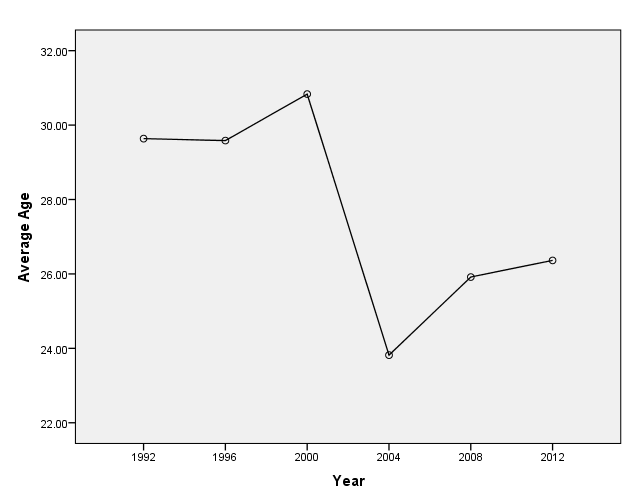
Stat1The mean ages (in years) for the Olympic teams were as follows: 1992 (29.64), 1996 (29.58), 2000 (30.83), 2004 (23.82), 2008 (25.92), and 2012 (26.36). There was a significant difference in mean age, F(5,63) = 7.48, p < .001. There were also linear (p < .001) and cubic (p = .07) trends, which would suggest a gradual decrease in age over time punctuated by a stark decrease in 2004 (the only year since 1992 that the US did not win a gold medal).

How were they different?

The 1992, 2004, 2008, and 2012 teams all had significantly lower ages than the 2000 team. What about the question of whether or not the 2012 team was younger than the 1992 team. Numerically, this is true. However, there was no statistical difference in age between these two teams. This, in plain terms, means that we cannot be certain that the difference in the ages is not due to chance.

Steals

Steals

Steals might seem like an insignificant statistic when considering the whole of a team, but there is something to be said about how defensive pressure impacts the game. The means for each Olympic year were as follows: 1992 (1.86), 1996 (1.58), 2000 (1.14), 2004 (1.42), 2008 (1.38), and 2012 (1.36). The only significant difference was between the 1992 team (which had the highest average steals) and the 2000 team (which had the lowest average steals). There was also a significant linear trend (p = .040), which would seem to imply a steady decrease in average steals since 1992.

Defensive Rebounds

DEfReb

Unfortunately, there was no real difference in defensive rebounds between the different Olympic teams. Based on the scale of the graph you might be inclined to think otherwise, but there was nothing significant about the different years. For numerical sake (because we know I love numbers), here are the average means for each year: 1992 (6.23), 1996 (5.47), 2000 (4.96), 2004 (5.33), 2008 (5.27), and 2012 (5.11).

Blocks
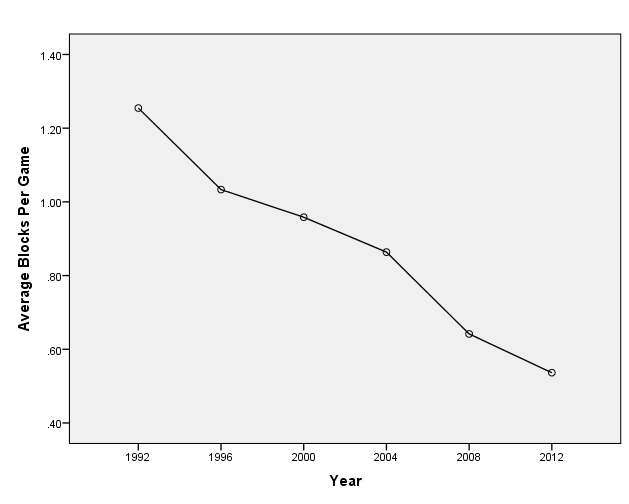
BLKAnother defensive statistic that certainly looks like it decreased over time. While there were no significant differences between groups, there was indeed a significant linear trend (p = .037) that would certainly suggest a decrease in average shots blocked from 1992 through 2012. To better visualize the data, the means were as follows: 1992 (1.26), 1996 (1.03), 2000 (.96), 2004 (.86), 2008 (.64), and 2012 (.54).

Free Throw Percentage
Free Throw

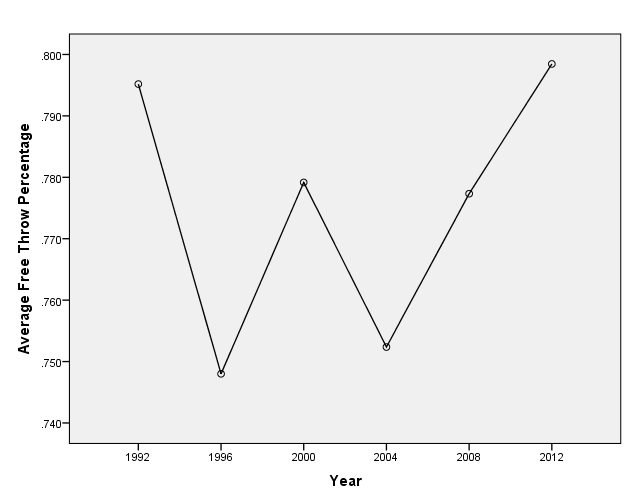
The graph would seem to suggest that there is a polynomial trend at work here, but that is not the case. There were not significant differences between Olympic teams. However, because I know how much you love numbers, here are the averages by year: 1992 (79.5%), 1996 (74.8%), 2000 (77.9%), 2004 (75.2%), 2008 (77.7%), and 2012 (79.8%)

Defensive Rating
DefRating

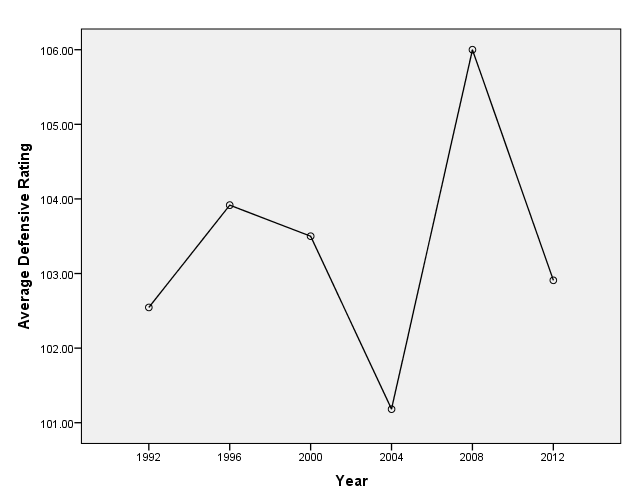
The Defensive Rating statistic is based on how many points were allowed per 100 possessions (The lower the number, the better the defense.) There were not significant differences between any particular teams, but there was a 4th order trend (p = .023) that would seem to suggest that at least teams were different enough from the predicted trend that they stood out (1992, 2004, and 2012). However, this does not tell us anything about how the teams are different from each other, only how they are different from an overall trend moving from 1992 until 2012. Moving from oldest to most recent, the average defensive rating by year was: 1992 (102.55), 1996 (103.92), 2000 (103.50), 2004 (101.18), 2008 (106.00), and 2012 (102.91).

Field Goal Percentage
Field Goal

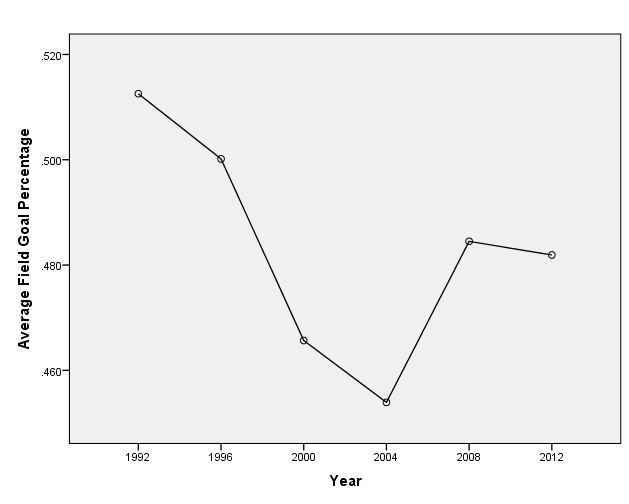
Field Goal percentage is how many shots were made relative to how many shots were taken. (This number excludes free throw percentage.) While there were no differences between the different Olympic teams, a quadratic trend was observed (p = .023) that shows a clear drop-off during the 2004 Olympics. It should be noted (again) that the 2004 team was the only team since 1992 not to win a gold medal. The averages by year were: 1992 (51.3%), 1996 (50.0%), 2000 (46.6%), 2004 (45.4%), 2008 (48.5%), and 2012 (48.2%).

Usage Percentage
Usage

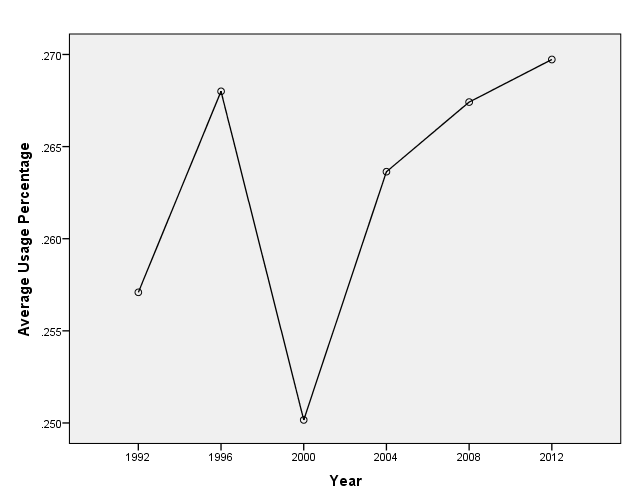
Usage percentage is an estimate of the percentage of team plays used by a player while he was on the floor. The graph would suggest much more is in play than the statistics reveal: there was nether an overall trend nor any differences between the groups. It is interesting to consider the averages from each team: 1992 (25.7%), 1996 (26.8%), 2000 (25.0%), 2004 (26.4%), 2008 (26.7 %), and 2012 (27.0%).
Height

Once again (thanks to the scale) there appears to be an overall trend of a small line-up, but there was neither a trend nor group differences to support that hypothesis. The means would suggest incremental differences (hence the lack of significance): 1992 (79.73), 1996 (79.75), 2000 (78.83), 2004 (78.91), 2008 (78.50), and 2012 (78.46).

Offensive Rating
Offrat

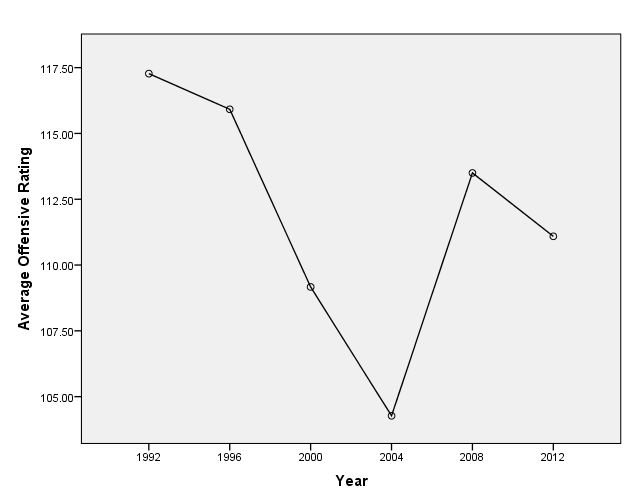
Offensive rating is the points produced per 100 possessions. There were indeed significant differences between the Olympic teams, F(5,63) = 5.54, p < .001. The 2004 team (109.17) had a significantly lower offensive rating than the 1992 team (117.27), the 1996 team (115.92), and the 2008 team (113.50). The 2000 team (109.17) and the 2012 team (111.09) were not different from any other group. There was as well a linear (p = .014) and quadratic (p = .002) trend, which would suggest a gradual decrease in offensive rating as well a dramatic dip in 2004.

Weight

Weight

Yet another statistic that was not meaningful in terms of helping us differentiate between teams. The averages (in pounds) are pretty close: 1992 (217.91), 1996 (224.75), 2000 (209.75), 2004 (221.82), 2008 (219.42), and 2012 (216.27).

True Shooting Percentage
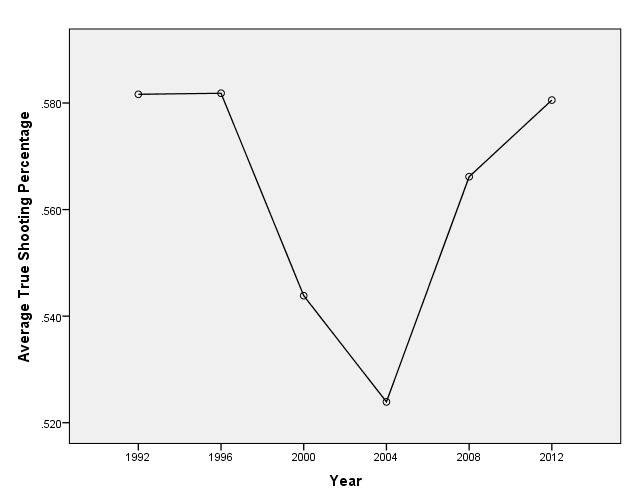
True Shoot

True shooting percentage is a measure of shooting efficiency that takes into account field goals, 3-point field goals, and free throws. There was indeed a difference in Olympic teams, F(5, 63) 4.895 , p = .001. The 2004 Olympic team (52.4%) was significantly lower than the 1992 team (58.2%), the 1996 team (58.2%), and the 2012 team (58.1%). The 2000 team (54.4%) and the 2008 (56.6%) were not significantly different from any other team. There was as well a quadratic trend (p < .001), which would seem to suggest a subtle drop-off in shooting efficiency in 2004.

Points Per Game

PPG

While the graph of PPG (Points Per Game) looks like there is something going on, I can assure you that there is nothing of statistical significance. The average points per game by Olympic year are as follows: 1992 (23.23), 1996 (22.21), 2000 (19.58), 2004 (19.79), 2008 (21.61), and 2012 (21.50).

PER (Player Efficiency Rating)

PER

John Hollinger created the PER statistic that he described as thus: “The PER sums up all a player’s positive accomplishments, subtracts the negative accomplishments, and returns a per-minute rating of a player’s performance.” There was a statistical difference between Olympic years, F(5,63) = 2.901, p = .020. However, follow-up tests yielded no difference between individual groups. The means are as follows: 1992 (23.71), 1996 (23.28), 2000 (19.96), 2004 (19.76), 2008 (22.06), and 2012 (22.99). There was a quadratic trend as well ( p = .003) that would suggest a lull during the 2000 and 2004 teams in terms of efficiency ratings of the roster.

Assists

AST

The Olympic teams were not significantly different from each other in terms of average assists per game. The averages for each year were as follows: 1992 (6.07), 1996 (5.18), 2000 (4.43), 2004 (4.18), 2008 (5.72), and 2012 (4.84)

Total Rebounds
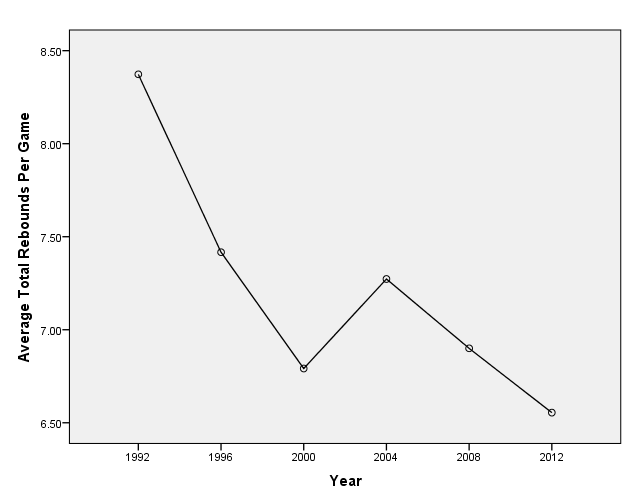
TOTReb

Sadly, total rebounds per game lacked a significant result as well. The averages were: 1992 (8.37), 1996 (7.42), 2000 (6.79), 2004 (7.27), 2008 (6.90), and 2012 (6.56).

Offensive Rebounds

OffReb

It should come as no surprise that offensive rebounds lacked significant findings as well. The averages were as follows: 1992 (2.16), 1996 (1.96), 2000 (1.83), 2004 (1.96), 2008 (1.62), and 2012 (1.48).

Conclusions

Making sweeping conclusions about statistical data is part of the fun for me. Basketball is a team sport where one individual can dramatically change the course of a game. An Olympic team is, in theory, comprised of the best players at a given time. The only team that was significantly different than any other year was the 2004 team, which was the only team since 1992 to not win a gold medal.

Does that mean we can say that the other teams are better?

Not necessarily.

All we can really say is that the other teams were more similar to one another (teams that won a gold medal) than they were different from the 2004 bronze-medal winning team. I imagine that is slightly anti-climatic. The reality is that looking at averages of all positions created a homogenized sample.